Microsoft Planner We re Still Setting Things Up Please Try Again Later
Planning to brand the movement to Office 365 this twelvemonth? Go expert advice during our upcoming webinar "Out Hustle The Hassle: Office 365 Migration Planning and Preparing!"
The Conference Modern Workplace Pros Don't Want To Miss

Increment your knowledge on Microsoft Planner through our blog serial
- How to Use Microsoft Planner
- 5 Smart Tips for Organizing Microsoft Planner
- Agile Project Direction with Microsoft Teams & Planner
- What To Use & When: Microsoft Project vs. Microsoft Planner
As a technical writer at AvePoint, I get a lot of input from unlike teams across the system. I get task requests from a SharePoint list, email, and meetings. Sometimes these tasks are small. Other times these tasks have lots of dependencies. More than likely than non though, these tasks are cantankerous-functional, shared by my team members, and phased over a few months.
This isn't new or news. In the modern workforce, anybody'south job is like mine — fast-paced and a lilliputian overwhelming. All of us have lots of stakeholders in all our work, and lots of people that can inquire for our help. To go on rails of piece of work, all of usa need some sort of chore management organisation.
What does an ideal task management arrangement have?
Having had a long career working with analog and on-prem tools, I've gained insight into what I really needed from a job management system:
- Data Hub: I want to become to one place to see everything. I don't mind drilling downward into an item to get a description of information technology, or a link to the document, or a comment chain, but I desire them all in the same place.
- Flexible Categorization: I can quickly reprioritize tasks, change their category or status, and tag them with helpful metadata.
- Comments and Advice: Sometimes all the tags and statuses aren't enough, and I want to leave myself helpful information, but I desire to surface it to the squad. Did I send this doc back for review? When?
- Insights: Help me empathize my squad's workload and prove off to my boss.
So what exercise I do to tame all these tasks and become things done with these needs in mind? Simply put, I use Planner integrated with Teams. Permit me tell you how I got there.
Old School Task Management
When I first started as a technical writer nine years ago, I had the same trouble I take now — also many inputs to go on runway of. At the time, I was a solo writer, and so I did whatever felt all-time. At first, I tried to go along a list on viscous notes, emulating all those absurd Kanban boards I saw on other people's desks. Things got lost.

Then I tried a bullet journal. If y'all haven't seen bullet journals on Pinterest, it is all the rage with bloggers and Instagrammers who have beautiful penmanship and a lot of free fourth dimension. I have neither of those, so I quickly lost rail, and I lost interest in the systems I built.
What Pinterest says my journal should look like:

What my journal really looks like:
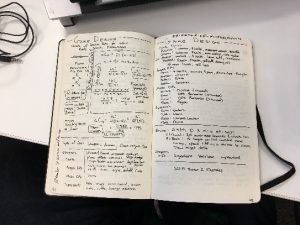
I even tried a white board. I thought this was the reply: totally flexible, non-permanent, meets my needs, and I tin putter. Doodling, non task management became the focus of the lath, and, like the other analog answers I came upwards with, it was abandoned.

How to Use Microsoft Planner: Chore Management in the Digital Historic period
When I came to AvePoint, my home-grown technical writing techniques needed a major overhaul. Our team is distributed across the globe and we have many simultaneous projects and deliverables in process at any given time. I had my own discrete tasks, and then I initially tried to digitize my earlier attempts with software like Trello and Wunderlist. These both worked for a time, but again, I couldn't communicate well with my squad because we were all on our own personal instances or didn't accept systems at all.
Before migrating to Office 365, we settled on using OneNote as an ad hoc task managing director. We made humongous tables with lots of columns and checkboxes and hyperlinks. In many means, this was a precursor to Planner. We'd make new tabs for specific projects or people, nosotros'd brand new lists, we'd color code, and tag, and collate data as best we could. Tasks, unfortunately, sometimes got lost in the shuffle or were misinterpreted. Furthermore, using OneNote like this was labor intensive, and I lost productivity by trying to be more than productive.

4 Means Planner Makes Piece of work Smarter
Planner provides me with the four main functionalities that I demand in a chore management system: an information hub, flexible categorization, advice, and insights.
Information Hub
Planner is a one-stop shop. Once you take your Program up and running, you'll never need multiple tabs of the same thing open once more. I tin can see everything in ane place. Here's what I do when I get into the function every day:
- In the morning, I check my email, Teams channels, and Groups for new assignments.
- I'll so add those tasks to Planner with a general description.
- If I know who will terminate up performing this task, I'll assign it to them; otherwise, I'll leave it unassigned until my team can sync upwardly.
- I'll break down any sub-steps or deliverables required for the job and use the checklist in the Planner card to make an itemized list.
- Since all our documents are in SharePoint, I'll have the links people transport me and add together those to the chore. If someone is silly enough to send me an zipper, I'll drib it into the appropriate SharePoint location and create a link.
One time I create a task in Planner, I only expect back to the originating email if I need to respond. This helps me stay out of the dreaded inbox and stay focused on work.
eBook: Plan Your Digital Transformation Roadmap for 2019!
By creating tasks in this way every time, I force myself to recollect critically about each one. The process is quick, and I break each task down into achievable sub-tasks to summarize what I must exercise.
Sometimes, more than one person will work on a chore. Thankfully, Microsoft has rolled out the power to assign tasks to multiple people. Announced in an article from Mansoor Malik, Principal Product Manager at Microsoft, and on the Office 365 roadmap, Planner now supports adding more than one owner to a task. I'thou honestly thrilled! Why? 2 reasons: ane) I don't have to indistinguishable tasks anymore, and 2) Microsoft listened to 1 of the biggest pains the customs was having and fixed it quickly.
Flexible Categorization
Planner's buckets are flexible ways to categorize your tasks. You can create as many buckets as you desire, with any name you desire, and add tasks to them with a uncomplicated drag and drop.
I use two types of buckets simultaneously — time buckets and project buckets. Time-oriented buckets assistance me sort miscellaneous tasks into groups based on when they are due, i.e., To Practice, In Progress, and On the Horizon. Project-based buckets collect all the tasks for a specific projection regardless of their due date, which helps me organize that project.
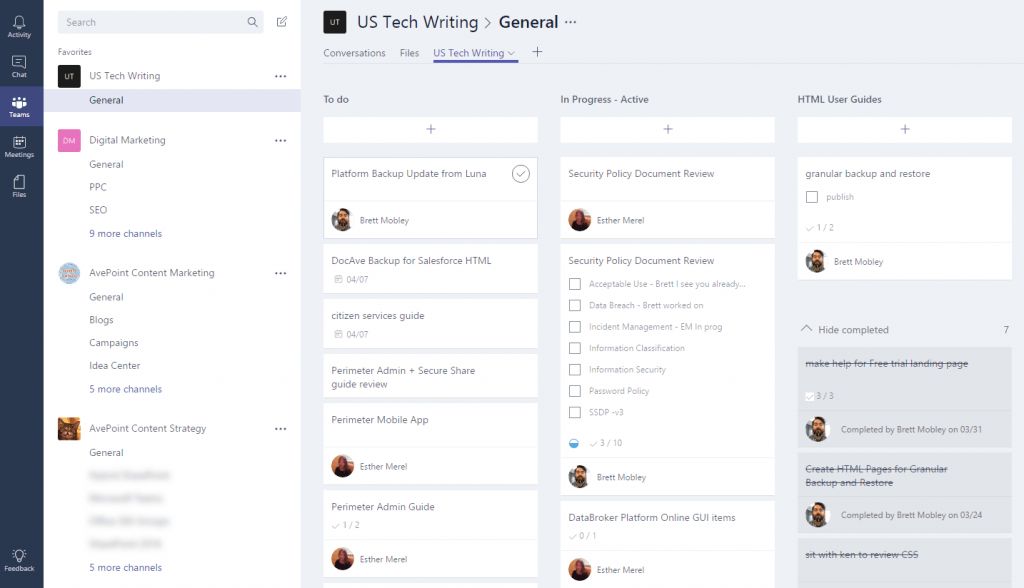
Buckets are crawly because they can exist added or deleted with ease, and calculation tasks to them couldn't be more simple. Furthermore, while Microsoft could have included a lot of bells and whistles for your buckets, they didn't. There is something freeing well-nigh the simplicity of grouping tasks up in a row.
Buckets aren't the end of Planner's flexibility, either. I personally similar to flip views sometimes and have planner group all tasks by possessor. This helps me see exactly what I need to do now.
Communication
Communicating about tasks with your team tin can sometimes exist a tricky suggestion. Maybe they aren't privy to the original email thread. Maybe they weren't in the meeting when yous were assigned a new project. Maybe they were but onboarded and barely know what is going on. This is where Planner's foundation, Groups, comes in.
On every job bill of fare, there is a comments section. When you lot leave a annotate at that place, you lot begin a chat in your Group'south mailbox, which is circulate to everyone in the Group. This is an excellent style to develop a culture of transparency around your tasks.
To exist more transparent with my team, I try to employ Planner'southward annotate feature to annotation important milestones that aren't sub-tasks. For instance, when I've reviewed a document, only haven't published it because I had questions for the writer, I will notation in the comments of the Planner card that I sent it back to the author. Doing so helps me keep a log of interactions, and helps me remember the subtler stage changes of the certificate.
Insights
Planner also gave me some functionality I didn't know I needed. Namely, soft analytics that aid me encounter if any of my team members are overloaded and show off my team'due south productivity to my bosses.

When I wait at the Charts overview in Planner, I can quickly go a sense of what is going on with my squad, who has a lot going on, who doesn't, and if any projects are tardily. When I identify that someone is overburdened, I tin can reprioritize to assist them out. Teamwork makes the dream work.
What We'd Similar to See More than of
Planner is slap-up. Now that I've settled into a rhythm and gear up some team practices, I feel like it has totally replaced all my other task management tools. However, Planner does take a couple rough edges that hold me up occasionally. I'd be thrilled if Microsoft improved the following:
- Syncing tasks: Considering Groups governance can be confusing at times, I'm in a lot of groups with a lot of plans. I'd similar to be able to sync all my tasks out to multiple groups so those stakeholders can run into what I'chiliad up to besides.
Microsoft has rolled out a new functionality that nearly gets at this pigment signal. Planner now supports creating a link to an individual task and sharing in Teams conversation. Currently, people who are not a part of the group exercise not seem to exist able to view these tasks. While this does facilitate some intra-group work, information technology doesn't assist my cross-functional team much.
- Exporting tasks: Currently you lot can't consign your completed task list from Planner to Excel or whatever other application. I'd similar to be able to export list of tasks so I can fiddle with them in pivot tables for certain important presentations.
- Mobile admission:There is no Microsoft Planner app correct now, but there were plenty of votes for both a Microsoft Planner Android app and an iOS app on UserVoice. The Planner team responded, saying mobile apps are in evolution and that they'll be working with the Groups team "to figure out all the right integration points."
What do you think near Microsoft Planner, and how does it aid y'all piece of work smarter? Let me know in the comments! Also be sure to subscribe to our web log.
More Resources on How to Utilize Microsoft Planner:
- Microsoft Planner Tutorial Click Here >
- Microsoft Planner Roadmap Click Hither >
- Microsoft Planner UserVoice Click Here >
Source: https://www.avepoint.com/blog/office-365/how-to-use-microsoft-planner-avepoint-technical-writers/

Post a Comment for "Microsoft Planner We re Still Setting Things Up Please Try Again Later"