Bulgogi Beef Bulgogi Beef Bowl Joy Teriyaki
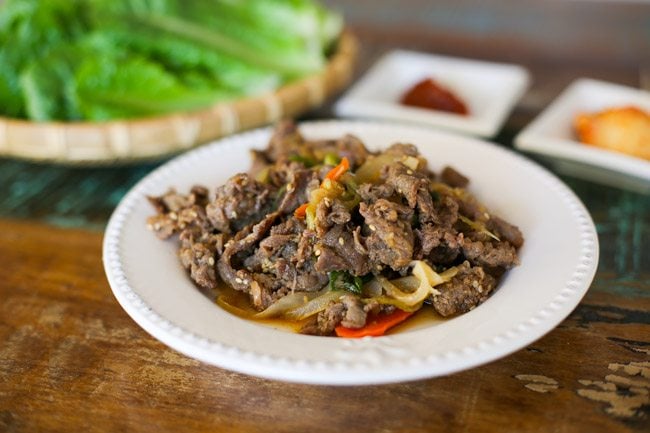
Your comprehensive guide to making the most succulent bulgogi (Korean BBQ beef) at home! With this, you can make mildly sugariness, savory, smoky, juicy and tender delicious bulgogi. Are yous excited?

WHAT IS BULGOGI
Literally speaking, bulgogi (불고기) means "burn down meat". It is often fabricated with tender parts of beef, pork or chicken. However, in general terms, unless specified, bulgogi is made with beef.
Undoubtedly information technology is one of the most well-known Korean traditional foods and it has been effectually for thousands of years. Naturally, the cooking method of bulgogi evolved over fourth dimension and it varies by region too.
Notwithstanding, to narrow our focus down, we will be talking about the well-nigh common mode of making beef bulgogi in modern times.
WHAT Cutting OF BEEF Do I Apply
As I briefly mentioned above, the tender parts of beef are platonic to utilize in bulgogi. And commonly used ones are superlative sirloin and beef tenderloin.
During my research though, I discovered that dissimilar countries take different naming conventions for these cuts, which fabricated me rather dislocated!
Anyway, I dearest making my bulgogi with scotch fillet (known as rib center in the United states of america). Information technology is a tad more expensive than other popular steak cuts, simply non as expensive every bit centre fillet (known as beef tenderloin in the US).
Scotch fillet / rib eye is known to take more than flavor and juicy texture than other steak cuts. It also has a expert amount of marbling, so cooking information technology over a grill or pan frying is quite suitable for this cut.
HOW TO CUT BULGOGI BEEF
Until recently, I've been exclusively using pre-cut bulgogi from a Korean grocer. Yeah, you tin buy this meat that'due south already sliced from a Korean grocer / Korean butcher. Just spotter out for the characterization "bulgogi meat" in the refrigerator / freezer section.
But I just became so unhappy with the degrading quality of meat I've been getting from my local Korean grocer. The meat wasn't fresh and information technology had too much gristle, so it was rather unpleasant to eat.
And so I decided to cut the meat myself with my choice of meat (scotch fillet / rib center fillet as I mentioned above) and this is what I do with it. (Tip – It's worth sharpening your pocketknife earlier you start this procedure!)
1. Take the meat out from the packaging. Wrap each fillet individually with cling wrap. Place the wrapped meat on to a metallic baking tray.
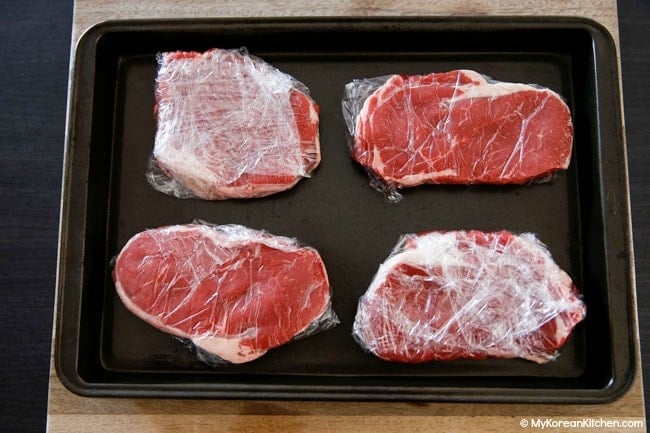
2. Put the tray into the freezer and let the meat partially freeze for about 2 to 2.five hours. (The time tin vary depending on your freezer setting, the thickness and size of the meat). The meat is fix if your knife goes through smoothly and you're not having difficulties in thinly slicing information technology. If you do, you lot should put the meat back into the freezer and freeze information technology a bit longer.
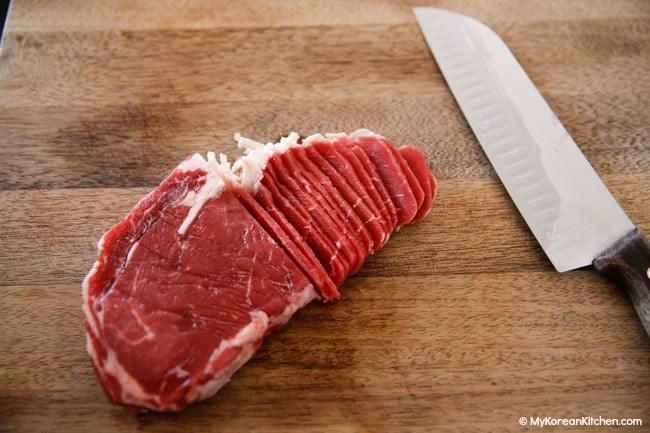
3. Remove the meat from the freezer and remove the cling wrap. Piece the meat thinly across the grain. Platonic thickness is 2mm to 3mm (1/viii inch). Now the meat is ready to be marinated with bulgogi sauce!
WHAT'S IN BULGOGI SAUCE
In my mind, bulgogi sauce is the whole reason why this dish is so addictively delicious.
It has a blend of soy sauce, brown sugar, asian pear (or red apple), garlic, ginger, ground black pepper and sesame oil. This gives a slightly salty, mildly sweet and nutty savory flavor.
TENDERIZING BEEF
As you tin can read from above, I use pear or apple in my bulgogi sauce. I employ them every bit a meat tenderizer merely also equally a sweet enhancer.
While the nigh commonly used fruit in bulgogi marinating process is Korean pear / Asian pear / Nashi pear, it is non an like shooting fish in a barrel fruit to get to if you don't live in Korea. And then I oftentimes utilize scarlet apple varieties (eastward.g. pinkish lady, red delicious, imperial gala, fuji etc.) combined with pureed onion and it has been working really well for me.
Some Koreans besides use kiwi or pineapple only you will have to make certain you don't overuse these every bit these are stronger tenderizing agents than pear.
If you marinate the meat for too long with these, the color and the texture of the meat can change essentially in an undesirable way. (I'thousand speaking from my own experience here!)
COOKING
- GRILLING vs. PAN FRYING
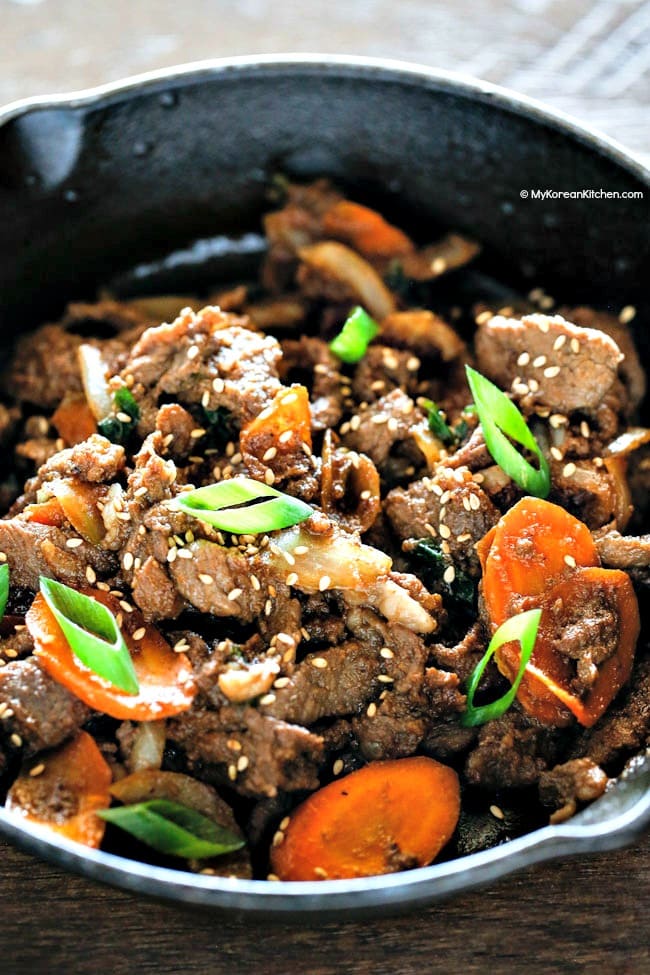
Bulgogi can be cooked with vegetables over a stove (in a pan / skillet) or it tin be cooked on a bbq grill without whatever vegetables. As you tin can imagine, they will give slightly different flavors.
Pan fried bulgogi (with vegetables) will naturally release some juice, which you tin use to mix with a basin of steamed rice. Many people dear this thought! This method is also keen if you're making bulgogi equally a meal prep.
On the other hand, char-grilled bulgogi (on a bbq) won't build any juice as it volition baste into the grill plate, but the extra flavor of slightly burnt charcoal, juice and the fat gives an irresistibly pleasant Korean bbq experience!
- Calculation SMOKY FLAVOR (WHILE PAN FRYING)
Tin you believe that you can add smoky flavor to your bulgogi even when you cook bulgogi in a pan? I won't concord you long.
The secret is cooking in a well seasoned bandage iron skillet and cooking in a small batch of meat without over crowding the pan.
Considering, when you over crowd the pan / skillet with the meat and/or vegetables, too much juice gets released from them. And the smoky effect gets diminished.
But you can terminate that happening by cooking bulgogi in a smaller batch. Cooking without whatsoever vegetables will also assist that too.
Too, some other hole-and-corner is, heating up the skillet high before you add together the meat, and then that as soon as the meat touches the pan, it starts sizzling, searing and caramelizing. This boosted flavour really does brand the bulgogi even more tasty!
WHAT TO SERVE WITH
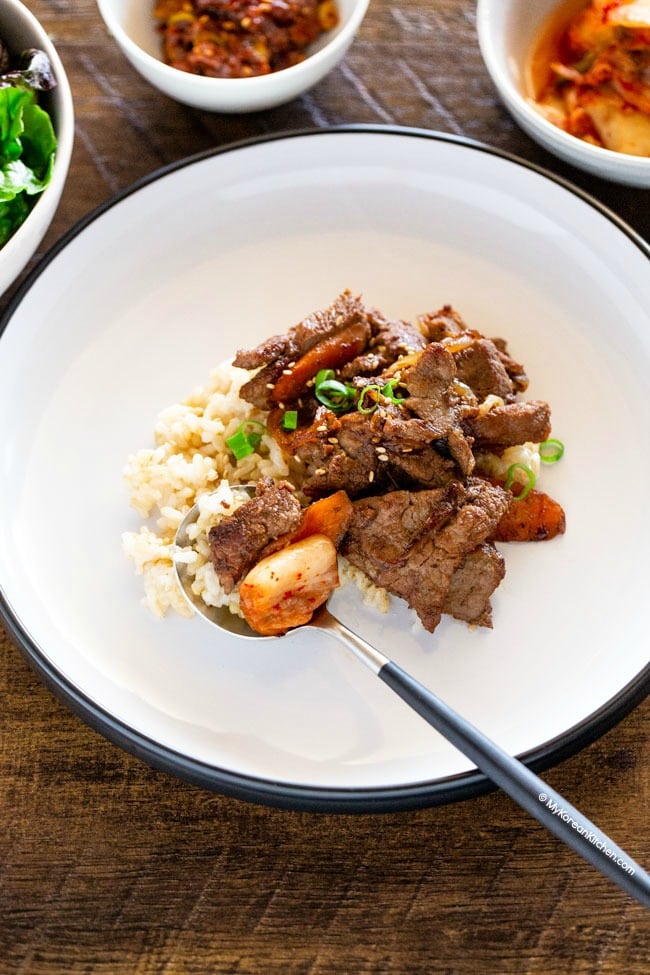
Serve the bulgogi with some steamed Korean rice and with other Korean side dishes.
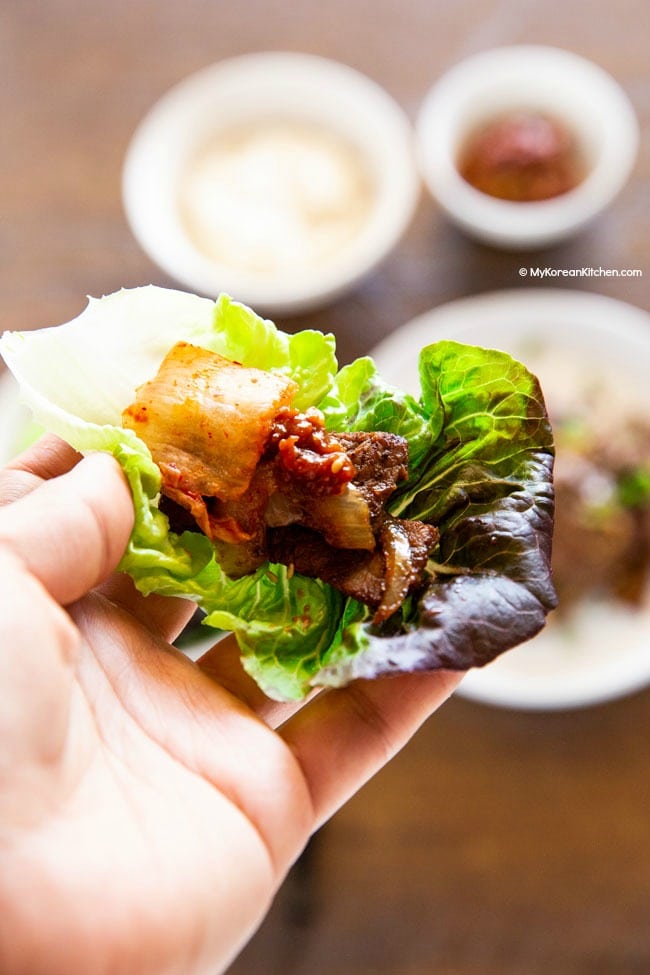
You tin can too use some lettuce leaves and perilla leaves to wrap the bulgogi. Don't forget to pair information technology with some Korean ssamjang (Korean bbq dipping sauce) and some kimchi (spicy or non-spicy) too!
HOW TO STORE
Cooked bulgogi can be stored in the fridge for a few days. Any uncooked portion of the bulgogi (only marinated) can be stored in the fridge for 3 to 4 days or in the freezer for a few weeks.
VARIATIONS
These are some creative ways to enjoy your favorite bulgogi at home. Sounds delicious!
- Bulgogi Spring Rolls (Perfect party finger food)
- Bulgogi Tacos (Great for DIY party)
- Bulgogi Rice Burger (Learn how to brand rice buns as well!)
- Bulgogi Pizza (The most popular pizza in Korea)
- Bulgogi Jeongol (aka Korean Beefiness Stew)
- Chicken Bulgogi (If yous adopt chicken
Boosted INFORMATION FOR KOREAN BBQ LOVERS
Bank check out my BBQ east-Book for more data on how to bask Korean BBQ at abode! (Information technology is free!)
INGREDIENTS FOR 4 TO 6 SERVES (Equally A Principal DISH)
MAIN
- 800 one thousand / 1.76 pounds rib eye or top sirloin (or whatsoever tender prime beef cutting), thinly sliced, 2mm to 3mm (1/8 inch) thickness
- ane onion (130 g / 4.6 ounces), optional, peeled & thinly sliced
- ii stalks green onion (55 thou / 2 ounces), optional, thinly sliced
- 1/2 carrot (55 g / ii ounces), optional, peeled & thinly sliced
- one Tbsp toasted sesame oil
- 1 Tbsp toasted sesame seeds
- 1 Tbsp cooking oil (I used rice bran oil)
BULGOGI MARINADE
- six Tbsp soy sauce (I use regular Kikkoman soy sauce)
- 3 Tbsp brown saccharide
- ii Tbsp rice vino (mirin)
- 1 asian pear or cherry apple (155 k / v.v ounces)
- one/2 onion (fourscore g / two.8 ounces)
- one Tbsp minced garlic
- ane tsp minced ginger
- 1/8 tsp ground black pepper
* 1 Tbsp = 15 ml
** If you want to learn more nearly Korean cooking ingredients, check my 30 essential Korean cooking ingredients list!
HOW TO Brand BEST BULGOGI
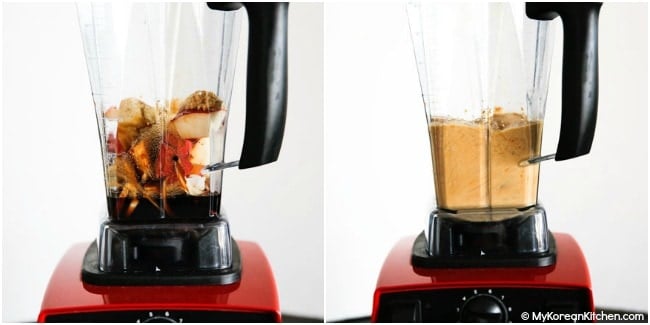
1. Blend the marinade ingredients in a mixer or food processor until smooth. Gear up aside.
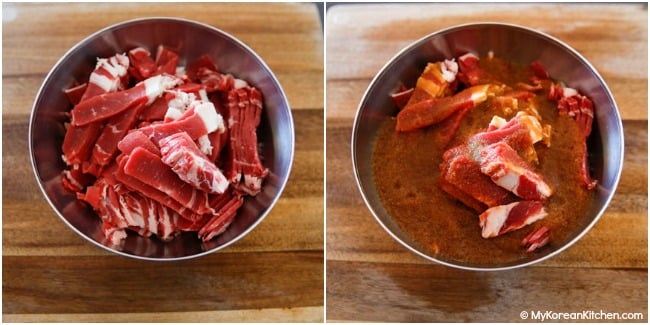
2. Place the thinly sliced meat in a mixing basin and pour the marinade over it. Mix them well together while gently massaging the meat with your easily. (Wearing a food prep glove is very handy hither!)
Add the sesame oil and mix it into the meat. (I prefer adding the sesame oil separately every bit opposed to mixing it in the marinade sauce. I read somewhere that the oil tin can foreclose the other sauce getting absorbed effectively into the meat.)
Cover the bowl with cling wrap (or move the marinated meat into a glass container with a hat) and marinate the meat for at least 4 hours in the fridge. (If you accept more time, you can as well marinate it overnight to deepen the flavour even more).
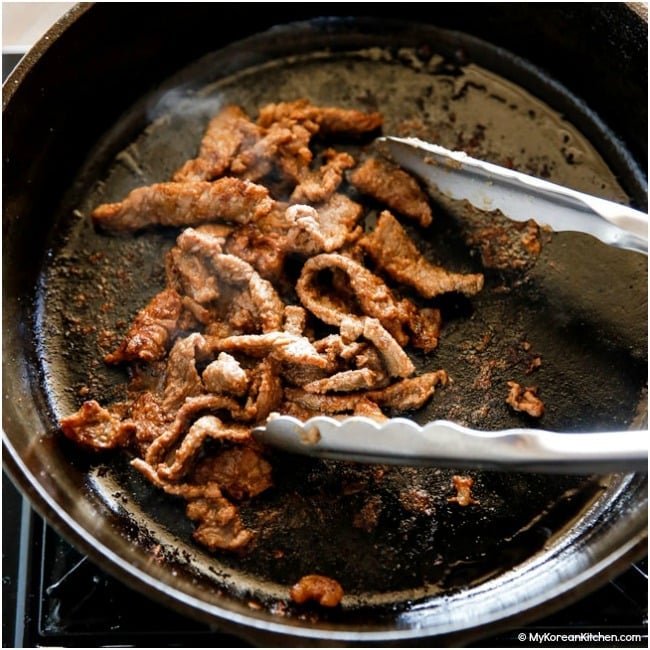
three. Preheat a skillet / bbq grill on medium high estrus until well heated. Add the cooking oil and spread it well. Add the meat (and vegetables) and melt information technology on medium high to high heat for 3 to 5 mins (until the meat and vegetables cook to your desired doneness). Toss in the sesame seeds and stir them apace.
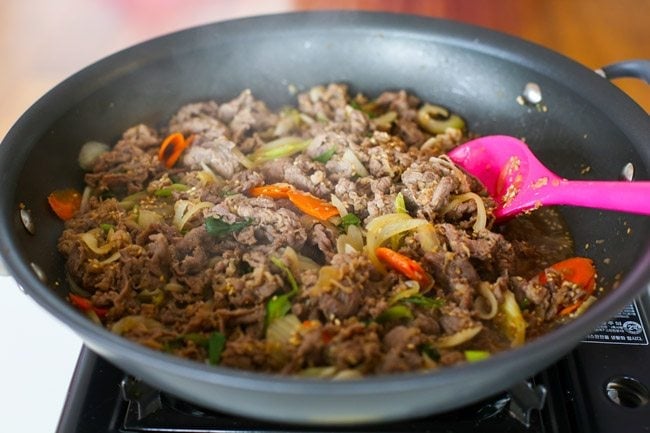
4. Serve the bulgogi with steamed rice and other Korean side dishes. (refer in a higher place for more tips)
Love Korean nutrient?Browse my other easy Korean recipes from this recipe index. And subscribe to my newsletter and follow along on Facebook, Pinterest and Instagram for all of the latest updates.
MAIN
- 800 chiliad rib center (1.76 pounds) or acme sirloin (or any tender prime number beef cut), thinly sliced, 2mm to 3mm (1/viii inch) thickness
- 1 onion (130 chiliad / 4.6 ounces), optional, peeled & thinly sliced
- 2 stalks green onion (55 chiliad / 2 ounces), optional, thinly sliced
- 1/2 carrot (55 thou / 2 ounces), optional, peeled & thinly sliced
- 1 Tbsp toasted sesame oil
- 1 Tbsp toasted sesame seeds
- 1 Tbsp cooking oil (I used rice bran oil)
BULGOGI MARINADE
- 6 Tbsp soy sauce (I utilize regular Kikkoman soy sauce)
- 3 Tbsp brown saccharide
- 2 Tbsp rice wine (mirin)
- 1 cherry-red apple tree or asian pear (155 yard / five.v ounces)
- ane/2 onion (80 g / ii.8 ounces)
- i Tbsp minced garlic
- 1 tsp minced ginger
- i/eight tsp ground black pepper
-
Blend the marinade ingredients in a mixer or food processor until smoothen. Set bated.
-
Place the thinly sliced meat in a mixing basin and cascade the marinade over it. Mix them well together while gently massaging the meat with your hands. (Wearing a nutrient prep glove is very handy here!)
Add the sesame oil and mix information technology into the meat. (I prefer adding the sesame oil separately as opposed to mixing it in the marinade sauce. I read somewhere that the oil can forbid the other sauce getting absorbed effectively into the meat.)
Cover the bowl with cling wrap (or move the marinated meat into a drinking glass container with a hat) and marinate the meat for at least 4 hours in the refrigerator. (If you accept more time, you lot can also marinate information technology overnight to deepen the flavour even more than).
-
Preheat a skillet / bbq grill on medium high heat until well heated. Add the cooking oil and spread it well. Add together the meat (and vegetables) and cook it on medium high to high rut for 3 to five mins (until the meat and vegetables cook to your desired doneness). Toss in the sesame seeds and stir them quickly.
-
Serve the bulgogi with steamed rice and other Korean side dishes. (refer to a higher place for more tips)
Calories: 436 kcal | Carbohydrates: 18 thou | Protein: 47 g | Fat: 17 g | Saturated Fat: four g | Cholesterol: 122 mg | Sodium: 1633 mg | Potassium: 864 mg | Fiber: ane 1000 | Sugar: xiii thousand | Vitamin A: 1335 IU | Vitamin C: 5.4 mg | Calcium: 108 mg | Iron: four.4 mg
The nutrition data shown is an estimate provided by an online nutrition estimator. It should not exist considered a substitute for a professional person nutritionist'south advice.
I honey hearing how you went with my recipes! Charge per unit this recipe with a comment below and tag me on Instagram @MyKoreanKitchen.
Source: https://mykoreankitchen.com/bulgogi-korean-bbq-beef/

Post a Comment for "Bulgogi Beef Bulgogi Beef Bowl Joy Teriyaki"